
Key Takeaways:
- A dedicated youth sports website builder does more than create a website; it helps manage registrations, schedules, payments, and communication from one platform.
- Sports-specific platforms often reduce administrative work compared to generic website builders that rely on multiple plugins and integrations.
- The best solution depends on your organization’s size, number of teams, and operational requirements.
- Features such as online registrations, payment processing, scheduling, and member management should be prioritized during evaluation.
- As clubs grow, an integrated platform can provide better scalability and a more consistent experience for athletes, parents, and staff.
A youth sports organization’s website is not just a place to publish schedules or just post team photos; it is involved in much more than that. They now serve as a central hub for the entire operation, seamlessly integrating registration, payments, communications, scheduling, and member management into one cohesive digital experience.
As clubs and leagues expand, the complexity of administration increases correspondingly. A program that oversees a few hundred athletes can lead to thousands of interactions throughout the season, including registrations, waiver submissions, fixture updates, payment notifications, volunteer coordination, and event announcements. When these tasks are managed through separate tools, operational inefficiencies become increasingly apparent.
This transformation has altered the expectations organizations have for a youth sports website builder. The assessment process now goes beyond just templates and aesthetics. Decision-makers require platforms that can facilitate daily operations, minimize manual tasks, and enhance the experience for families without adding to staff workloads. The market has adapted to this change. Some platforms concentrate solely on website creation, while others integrate website functionality with club management, league administration, and financial processes. Recognizing this distinction is crucial, as choosing the wrong system can lead to additional software and disjointed data.
This guide explores the top platforms for youth sports website builders available today, comparing their features, advantages, and ideal use cases to help organizations select the most suitable website builder for sports teams and sustainable program development.
10 Best Youth Sports Website Builders
There is much more available on a modern youth sports website than just schedules and contact information. Throughout the season, an efficient platform can manage payments, manage memberships, arrange teams, streamline registrations, and keep players, parents, and staff informed. For clubs, leagues, academies, and community organizations looking to improve their online presence and daily operations, the following solutions combine website capabilities with sports administration tools.
- Waresport
Website management is handled by Waresport as part of a larger plan for club operations. It links public-facing sites with registrations, memberships, scheduling, payments, and internal administration rather than using the website as a stand-alone marketing tool. As a result, companies can manage athlete experiences from registration to continued involvement in a single digital environment without depending on multiple systems.
Clubs that want to lower operational friction and have progressed beyond basic website requirements may find the platform very useful. By controlling daily operations from a single dashboard, administrators may minimize redundant data entry and the need for several third-party apps while maintaining a polished web appearance. This integrated strategy may be more sustainable for long-term growth-oriented firms than putting together different technologies for every administrative task.
Key Features
- Custom website builder
- Online registrations and waivers
- Membership management
- Payment processing
- Scheduling and calendars
- Team and player management
- Communication tools
- Mobile-friendly design
Best For: Youth sports clubs, academies, and leagues seeking an integrated management platform.
- SportsPlus
The foundation of SportsPlus is operational effectiveness. Organizations may post information while handling registrations, events, and financial transactions from the same platform thanks to its website features, which are tightly linked to routine administrative tasks. This can lessen the amount of manual coordination needed over the course of a season for groups managing several programs.
Its integrated approach is especially applicable to organizations that manage community events, seasonal registrations, and recurrent programs. SportsPlus gives members a more efficient digital experience while assisting administrators in maintaining consistency across various activities by connecting operational data with public-facing information.
Key Features
- Website management
- Online registrations
- Payment collection
- Scheduling tools
- Tournament support
- Communication features
Best For: Clubs and leagues operating multiple sports programs.
- TeamLinkt
TeamLinkt is intended for businesses looking to update their administrative procedures without adding needless complexity. The platform makes it simpler for administrators to keep members informed and events planned by striking a balance between website functionality and useful features for team management.
The tool is useful for leagues that need to effectively manage teams, communicate updates, and plan seasonal events since it is designed with accessibility and usability in mind. Its website capabilities serve as a focal location where participants and relatives may obtain crucial information while administrators handle activities behind the scenes.
Key Features
- Sports website creation
- Team scheduling
- Registration management
- League administration
- Messaging tools
- Mobile applications
Best For: Community leagues and local sports organizations.
- SportMember
SportMember uses the website as a portal for member interaction and organizational management, placing club administration at the core of its platform. It integrates communication, attendance, and event organization into a single solution to assist sports groups’ daily needs.
This integrated structure can streamline administrative processes and increase club exposure for groups with active memberships and regular events. Administrators gain from having operational data arranged in a single system, while members have a single location to retrieve information.
Key Features
- Club website tools
- Member management
- Attendance tracking
- Event scheduling
- Payment administration
- Team communication
Best For: Membership-based sports clubs and associations.
- ClubSpark
ClubSpark was created to assist sports groups in lowering administrative costs while strengthening their digital relationships to their communities. By integrating booking and membership processes with website capabilities, the platform enables clubs to handle participant interactions using a single system. Organizations can concentrate these operations into a single environment instead of keeping separate tools for operational duties and public information.
Clubs that oversee regular events and community initiatives will find this method very helpful. By facilitating member participation, facilities reservations, and registrations, the website transcends its role as an information gateway. Participants’ experiences can be enhanced by this integrated framework, which also gives administrators more control over daily operations.
Key Features
- Website builder
- Facility and court bookings
- Membership management
- Event scheduling
- Payment collection
- Communication tools
Best For: Community sports clubs and recreational organizations.
- Wild Apricot
Membership-based organizations that require a website in addition to administrative capabilities frequently utilize Wild Apricot. By linking websites with event management, communication, and membership data, the platform prioritizes long-term involvement rather than just acquiring new members. This enables organizations to give their communities a better organized digital experience.
Maintaining correct member data and streamlining routine administrative procedures may be just as crucial for nonprofits and sports groups as website design. In order to assist businesses decrease manual labor while maintaining member connections throughout the year, Wild Apricot integrates operational operations into a single platform.
Key Features
- Website creation
- Membership management
- Event registration
- Contact database
- Online payments
- Email communication
Best For: Sports associations and nonprofit organizations.
- ClubExpress
ClubExpress is intended for businesses that need a more organized administrative structure. It is appropriate for clubs that oversee committees, volunteers, and regular organizational operations since its website features are strongly related to membership governance, event planning, and document management.
The platform covers the more comprehensive administration needs that are frequently present in well-established sports businesses, as opposed to functioning as a straightforward website builder. ClubExpress helps clubs retain operational continuity while lowering the difficulty of maintaining numerous platforms by integrating internal administration with public-facing data.
Key Features
- Website management
- Membership database
- Event administration
- Online payments
- Communication tools
- Document management
Best For: Established clubs and membership-driven sports organizations.
- TeamUnify
TeamUnify was created to assist sports organizations that depend on regular events and set seasons. Clubs have a single spot to handle registrations, communications, and event-related activities all year long because to the integration of its website functions with member administration.
Organizations that must manage sizable participant groups while preserving accurate member information and operational visibility will find the platform very useful. TeamUnify reduces redundant labor and fosters a more cohesive experience for players, family, and staff by integrating website maintenance with routine administrative procedures.
Key Features
- Team websites
- Member registration
- Event management
- Payment processing
- Club communication
- Member database
Best For: Swimming clubs and aquatic sports organizations.
- Pitchero
Pitchero helps organizations stay in touch with players, supporters, and volunteers by combining club management tools with website publication. The website offers organized access to matches, team updates, and member activities while maintaining up-to-date club information.
Maintaining communication between various groups might become more difficult for clubs that oversee several teams. In order to deliver a consistent digital experience while meeting the administrative needs of an active season, Pitchero connects operational data with website content.
Key Features
- Club website builder
- Fixtures and results
- Team management
- Player profiles
- Club news publishing
- Communication features
Best For: Team-based sports clubs and local leagues.
- SpoersEngine Motion
SportsEngine Motion has developed into a comprehensive administrative platform that helps businesses oversee several teams and initiatives. Its website features are linked with scheduling, communication, and registration procedures, assisting clubs in combining tasks that are frequently spread over many systems.
Maintaining uniformity in participant data and public messaging becomes more crucial as organizations expand. By connecting website administration with operational procedures, SportsEngine Motion overcomes this difficulty by giving members a single information source and enabling administrators to plan events using a more cohesive digital framework.
Key Features
- Website management
- Online registrations
- Scheduling tools
- Team communication
- Payment processing
- Mobile accessibility
Best For: Growing sports organizations managing multiple teams and programs.
Key Features to Look for in a Youth Sports Website Builder
Selecting a youth sports website builder is more than just a style choice. For the majority of organizations, players, parents, coaches, volunteers, and administrators use the internet as their main communication channel. When registrations, payments, and communications are handled elsewhere, a platform that just publishes information may appear attractive, but it frequently results in extra administrative labor.
The best systems integrate operational capabilities with online features to streamline club administration and enhance the overall member experience. The following features should be given special consideration while assessing a platform.
Digital Forms and Online Registration
In addition to adding needless administrative burden, manual registration procedures raise the possibility of erroneous or missing data. Online registrations, digital waivers, document uploads, and forms that can be customized to fit various programs and age groups should all be supported by a modern platform. Additionally, a single registration procedure streamlines record administration throughout the season and gives organizations better insight into participation trends.
Payment Processing Integration
Reconciliation issues frequently arise when membership fees, program registrations, tournament entries, and recurring payments are collected via different systems. Organizations may handle financial transactions from the same platform that handles participant data due to an integrated payment solution. In addition to increasing operational effectiveness, this makes life easier for families.
Calendar Management and Scheduling
One of the most popular parts of any sports website is the schedule. Administrators should be able to post information in real time about practices, games, competitions, camps, and special events on the site. A dynamic scheduling system helps guarantee that all parties are using the same information and lessens misunderstanding.
Management of Teams and Members
Managing athletes, coaches, volunteers, and staff using spreadsheets gets harder as organizations grow. Centralized member profiles, roster management, and administrative controls that streamline daily operations should be features of a specialized sports team website builder. Having a structured database also supports future planning and organizational growth.
Tools for Communication
For young sports groups, where schedules and logistics are always changing, consistent communication is crucial. Administrators can effectively disseminate updates without depending on several third-party apps thanks to built-in messaging and notification functionality. Additionally, a centralized communication system lowers the possibility that crucial information would be overlooked.
A Mobile-Friendly Experience
Most families use mobile devices to communicate with sports groups. The experience should be the same on PCs, tablets, and smartphones, whether customers are checking timetables, completing registrations, or making payments. Mobile responsiveness is becoming a fundamental operating need rather than an optional feature.
Personalized Branding and Adaptability of Websites
An organization’s identity should be reflected on its website. Clubs may build a professional appearance and increase community awareness by customizing layouts, colors, logos, and domains. Additionally, without the need for technical know-how, flexible content management enables companies to post announcements, highlight accomplishments, and promote initiatives.
Management of Membership and Subscriptions
Recurring memberships or seasonal renewals are essential for many sports groups. A platform that facilitates participant history, automated renewals, and membership monitoring may greatly save administrative work while increasing retention. As clubs add more programs and broaden their offerings, this feature becomes more and more important.
Administrative and Reporting Perspectives
When operational choices are backed by reliable data, they are more successful. Administrators can keep an eye on program participation, membership growth, registration, and payment activities with the use of reporting tools. Organizations may utilize these insights to enhance planning and more efficiently allocate resources instead of gathering data by hand.
Scalability and Integration
A website platform must to be able to expand together with the company. The underlying system should accommodate clubs’ expansion into new teams, locations, programs, or facilities without necessitating a whole technological overhaul. Organizations may prevent fragmented processes and redundant data entry by integrating with payment gateways, communication tools, and other administrative systems.
Security and Data Management
Youth sports organizations manage personal information, payment records, and sensitive participant data. A reliable platform should provide secure data handling practices and role-based administrative access to help protect organizational information. As digital operations become more important, security should be considered a core platform capability rather than an afterthought.
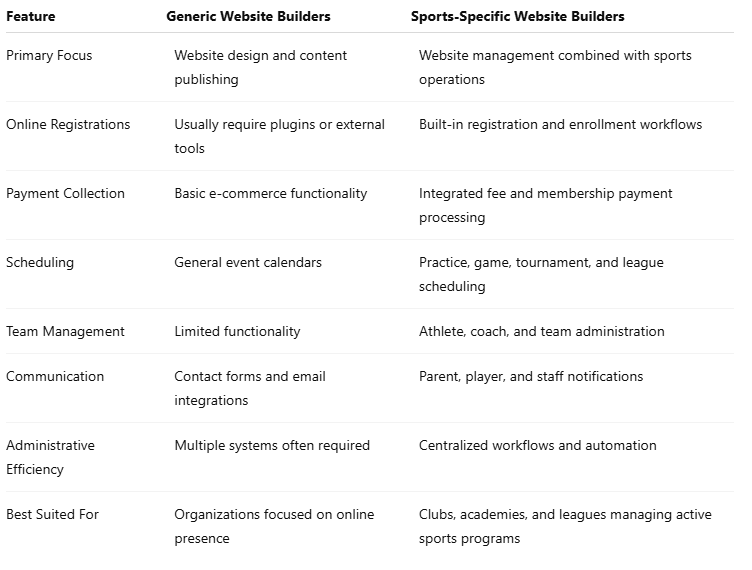
Generic Website Builders vs. Sports-Specific Website Builders
A generic website builder can help an organization establish an online presence, but youth sports operations often require far more than content management and design flexibility. Registrations, memberships, payments, scheduling, and team administration are operational processes that typically require additional plugins or third-party applications on a traditional website platform.
These standards guide the development of a sports-specific website builder. Instead of seeing the website as an independent marketing tool, it integrates the digital experience with the administrative activities that keep clubs and leagues running efficiently. Firms planning long-term expansion can lessen software fragmentation and simplify day-to-day administration.
Why Youth Sports Organizations Need a Dedicated Website
One Place for Everything Parents Need
Rarely do parents want to look for practice schedules or registration dates in old emails, group conversations, and social media postings. They have a single, dependable source of information regarding programs, forthcoming events, prices, policies, and team updates due to a dedicated website. Administrators spend more time assisting athletes and coaches and less time responding to the same inquiries when information is readily available.
Less Time Spent on Administration
Spreadsheets, paper forms, and manual payment monitoring are still used by many youth sports groups. These approaches could be effective for a small program, but as participation increases, they become challenging to oversee. By combining registrations, schedules, payments, and member data, a specialized sports website builder helps cut down on the amount of tedious administrative labor that takes place in the background.
Better Communication Throughout the Season
As communication is spread across several channels, it may be difficult to keep everyone up to date as schedules change, weather cancels events, and tournament details alter. A dedicated website makes it easier for parents, players, and coaches to remain in touch throughout the season by providing a centralized location for announcements and important information.
A More Professional First Impression
For many families, a website is the first interaction they have with a club or league. An outdated website, or no website at all, can make an organization appear less established than it actually is. A professional online presence helps build trust, provides clear information about programs, and makes it easier for prospective members to understand what the organization offers.
Built to Support Growth
As clubs add more teams, programs, and participants, administrative demands naturally increase. Processes that once felt manageable can quickly become difficult to maintain. A dedicated sports team website builder provides a stronger foundation for growth by helping organizations manage increasing participation without adding unnecessary complexity.
Choosing a Platform That Can Grow With Your Organization
It’s not always the case that the best rated youth sports website builder offers the most design options or themes. How well it meets a sports organization’s daily demands determines its true worth. Families’ experiences with a club are influenced by a number of factors, including member management, scheduling, payments, and communication.
For this reason, a lot of organizations are switching from general website tools to sports-specific platforms. Organizations may manage both their online presence and day-to-day operations from a single platform by utilizing solutions like Waresport, which integrate website functionality with club administration features. Having the appropriate digital foundation may significantly improve member experience and efficiency as participants and parents’ expectations continue to grow.
The best website builder for soccer clubs depends on the club’s size and operational needs. Organizations that manage registrations, memberships, schedules, and payments often benefit from sports-specific platforms that combine website functionality with club management tools rather than relying on a standalone website solution.
Pricing varies significantly based on features, number of users, and organization size. Entry-level platforms may start at a modest monthly fee, while comprehensive sports management solutions with registrations, payments, scheduling, and membership management typically offer custom pricing based on usage and requirements.
Yes. Most modern sports-specific platforms allow organizations to manage multiple teams, age groups, and programs from a single website. This makes it easier to maintain schedules, registrations, communications, and member information in one centralized location.
A generic website builder primarily focuses on design and content management. A sports website builder includes features such as online registrations, team management, scheduling, payment processing, and member communication, making it better suited for clubs and leagues.
Most sports-specific platforms include online registration forms, waiver collection, participant management, and payment processing. This helps organizations reduce paperwork and streamline the enrollment process for parents and athletes.
Yes. Many platforms support recurring memberships, seasonal fees, program registrations, and other payment types through integrated payment processing systems, making financial management more efficient.
Key features include online registrations, payment collection, scheduling, team management, communication tools, mobile responsiveness, membership management, and reporting capabilities. The right combination will depend on the organization’s size and growth plans.
Even smaller clubs can benefit from a sports-specific platform if they spend significant time managing registrations, schedules, and communication manually. Consolidating these tasks into one system can save time and improve the experience for members and families.
This is what we built Waresport for