
Key Takeaways:
- Time loss in sports clubs is driven by coordination inefficiencies, not workload volume
- AI-powered sports scheduling software reduces manual planning by resolving complex constraints automatically
- Modern sports club management software minimizes repetitive admin work by centralizing operational data
- Real-time system visibility significantly reduces communication overhead
- Platforms like Waresport help clubs save time by unifying fragmented workflows into a single operational system
Sports Club Management Software & Sports Scheduling Software: Sports Clubs Don’t Have Time Problems — They Have System Design Problems
When sports clubs talk about operational challenges in 2026, one phrase comes up repeatedly:
“We don’t have enough time.” In reality, time isn’t the constraint, system design is.
Across coordination-heavy environments, a significant share of effort is spent managing workflows rather than executing them. The McKinsey Global Institute estimates that nearly 28% of the workweek goes into communication, while Harvard Business Review highlights the steady rise of coordination-heavy activities.
Sports club operations reflect the same pattern.
Administrative effort is absorbed by scheduling changes, repeated communication, attendance tracking, and payment follow-ups, often across disconnected tools with no shared operational state. As a result, even small updates trigger multiple manual steps.
This is where AI in sports management begins to change the structure of operations.
AI-powered sports scheduling software evaluates constraints dynamically, reducing conflicts before they occur. At the same time, sports club management software automates workflows, ensuring that updates across scheduling, communication, attendance, and payments are triggered and reflected in real time. The result is not just faster execution, but fewer coordination cycles.
Platforms like Waresport bring this together into a unified system, where work is completed once, updates flow automatically, and time is recovered by eliminating repetition, not accelerating it.
Why 2026 Is a Different Kind of Pressure Year For Sports Management Software Firms
The pressure on sports clubs has not just increased, it has changed in nature. By 2026, many operational methods that worked at smaller scales are no longer sustainable under growing complexity.
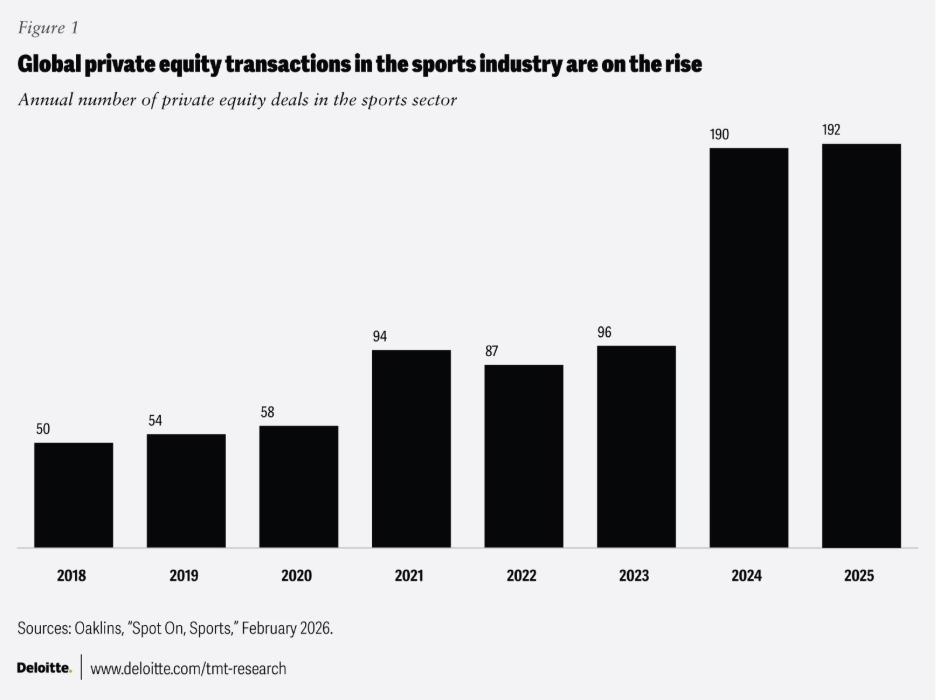
Source: Deloitte
One of the biggest shifts is scale density. Clubs now manage multiple age groups, overlapping sessions, and shared venues within tight time windows. In this environment, even a small scheduling change does not stay isolated. A single adjustment, like coach availability or venue reassignment, can cascade across multiple sessions, affecting players, coaches, and facility usage at once.
At the same time, expectations have shifted toward immediacy. Players and parents expect real-time visibility into schedules. When updates are delayed, it creates uncertainty, which quickly turns into repeated queries, follow-ups, and additional administrative effort.
This is further compounded by operational volatility. Weather changes, last-minute adjustments, and coach availability issues are no longer occasional, they are continuous. In manual systems, each disruption triggers a chain of actions: rescheduling, notifying, confirming, and updating records. What should be a single change becomes a multi-step process.
These factors do not cause immediate failure. Instead, they gradually increase the effort required to maintain coordination. Over time, the system becomes harder to manage, as administrative overhead grows faster than operations themselves.
This is where sports scheduling software and sports club management software begin to play a structural role. Modern systems treat scheduling as dynamic rather than fixed, continuously evaluating constraints like availability and capacity. At the same time, integrated sports club management software ensures that any update is reflected instantly across communication, attendance, and operational tracking.
The result is not just faster execution, but a system that remains consistent and responsive without constant manual intervention.
Mapping Time Consumption Across Club Management Systems
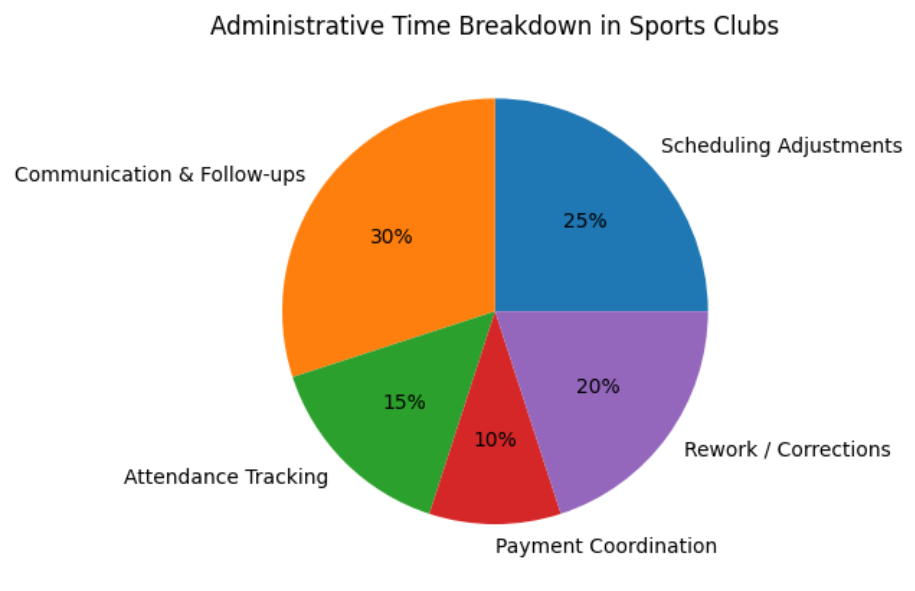
A significant portion of time in sports club operations is consumed by communication, follow-ups, and scheduling rework, largely driven by fragmented workflows rather than task complexity. When systems operate without a unified operational state, even minor updates expand into multi-step coordination efforts.
This becomes evident in how delays compound. A schedule change triggers communication, which requires confirmation, and eventually leads to updates in attendance or participation. Because these steps occur sequentially rather than in parallel, each stage depends on the previous one. Over time, this creates repetition, with the same actions revisited across different stages of the workflow. As a result, administrative effort shifts from execution to coordination, leaving clubs busy but not necessarily more efficient.
Attempts to address this by adding staff, tools, or communication channels often increase complexity. Each addition introduces new dependencies, further fragmenting workflows instead of aligning them.
A more effective approach is to connect these workflows within a single system. Modern sports scheduling software and sports club management software reduce dependencies by aligning scheduling, communication, attendance, and payments in real time. Updates are applied once and reflected consistently across the system, which becomes increasingly important in multi-club and facility management environments where coordination overhead is higher.
- Fewer scheduling conflicts through better constraint handling
- Reduced communication overhead with real-time updates
- Improved consistency across attendance, payments, and participation
- Better control across multi-club and facility management operations
- Elimination of repeated actions through connected workflows
The 5 Most Common Bottlenecks and How to Fix Them
Time loss in sports clubs is rarely caused by individual tasks. It emerges from how scheduling, communication, attendance, and payments interact within daily operations. When these workflows are disconnected, even simple actions expand into multi-step coordination processes.
The breakdown tends to follow consistent patterns. The table below outlines the most common bottlenecks, how they appear in practice, their root causes, and what resolves them at a system level:
| Bottleneck | What it looks like | Root cause | The fix |
| Scheduling conflicts | Frequent rescheduling and overlaps | Constraint overlap (coach, venue, team) | AI-driven sports scheduling software |
| Communication overload | Repeated questions and confirmations | Lack of real-time visibility | Centralized sports club management software |
| Attendance errors | Inconsistent or delayed records | Manual tracking after sessions | Real-time attendance systems |
| Payment delays | Constant follow-ups and verification | Disconnected financial workflows | Integrated payment tracking |
| Data fragmentation | Multiple tools with inconsistent data | No unified system of record | Integrated sports management platform |
Although these bottlenecks appear distinct, they are rooted in a single structural issue: lack of integration across core systems.
In most sports clubs, scheduling, communication, attendance, and payments operate as separate processes, each with its own data and logic. There is no shared operational state connecting them. As a result, even minor changes do not remain contained. A schedule adjustment must be communicated, confirmed, and then reflected across attendance and payment records, introducing dependencies at every step.
Over time, this creates a cycle of repeated effort. Work is not inherently complex, but it is continuously revisited across disconnected workflows. This is why administrative workload expands without a proportional increase in efficiency.
Most clubs attempt to solve this by optimizing individual tasks, improving scheduling, responding faster, or tightening attendance tracking. In practice, this has limited impact because the inefficiency lies in the connections between tasks, not the tasks themselves.
This is where AI in sports club management begins to play a meaningful role, not as a standalone capability, but as part of an integrated system. AI-powered sports scheduling software evaluates constraints dynamically, reducing conflicts before they surface. At the same time, AI-enabled automation within sports club management software ensures that updates, whether in schedules, attendance, or payments, are processed and synchronized in real time.
Instead of triggering chains of follow-ups, actions are executed once and propagated across the system. Dependencies are reduced, coordination cycles shrink, and operational workflows become more predictable.
In this model, efficiency is no longer driven by working faster. It is achieved by eliminating fragmentation and reducing the need for repeated intervention, which is where the most significant time savings occur in modern sports club management.
How Sports Club Management Software & Sports Scheduling Software Reduce Operational Complexity
Operational complexity in sports clubs is reduced when scheduling and management systems shift from manual coordination to AI-driven, real-time workflows. Instead of handling tasks sequentially across disconnected tools, modern systems create a unified operational layer where updates are processed once and reflected everywhere.
At the core of this shift is AI-powered sports scheduling software, which evaluates constraints, coach availability, venue capacity, team allocation, and timing, simultaneously. Scheduling becomes adaptive rather than reactive, reducing conflicts, minimizing rescheduling, and stabilizing operations as scale increases. In parallel, AI-enabled sports club management software ensures that operational data is not just stored, but continuously synchronized. Schedule changes, attendance tracking, communication, and payment status are automatically aligned, eliminating the need for manual verification and repeated follow-ups.
This becomes particularly critical in environments involving multi-club management, facility management, and shared resource planning, where dependencies are higher and coordination overhead increases rapidly without system-level automation.
The result is a transition from fragmented workflows to a connected, intelligent system, where decisions are processed within the platform, not across emails, calls, and manual updates.
In practical terms, this leads to:
- Fewer scheduling conflicts through AI-based constraint optimization
- Reduced communication overhead with event-driven, real-time updates
- Accurate attendance and payment alignment without manual reconciliation
- Scalable operations across multiple clubs, teams, and facilities
- Consistent data visibility across all stakeholders within a single system
Complexity is not reduced by working faster, it is reduced by eliminating the need to coordinate repeatedly across disconnected processes.
Redefining Time Through System Design and AI for Sports Scheduling Software
Time inefficiency in sports clubs is often incorrectly blamed on the workload. In practice, it is a consequence of how operations are structured. When scheduling, communication, attendance, and payments function as separate processes, each action expands into multiple steps. A schedule change requires communication, communication leads to confirmation, and confirmation drives updates across other systems. Each dependency introduces delay, and each delay compounds over time.
At smaller scales, this structure can be managed. As operations grow, it becomes a limiting factor. The shift occurs when these workflows are integrated. With sports club management software and sports scheduling software operating within a shared system, actions no longer need to be repeated across layers. Scheduling decisions, communication updates, attendance tracking, and payment status are maintained within a unified operational state, where a single update is reflected across all relevant functions.
AI further strengthens this system by changing how decisions are executed.
- Constraint evaluation becomes simultaneous, allowing schedules to adapt without manual recalculation
- Updates propagate in real time, removing delays between action and awareness
- Data consistency is maintained automatically, reducing the need for reconciliation
The impact is not limited to speed. It is reflected in how the system behaves, fewer interruptions, fewer dependencies, and fewer repeated actions.
Time savings, in this context, are not achieved by compressing tasks. They are achieved by eliminating the need to perform the same task multiple times.
From Operational Complexity to Scalable Systems with Waresport
For sports clubs, the challenge is not simply managing current operations, it is maintaining control as those operations expand. In fragmented environments, growth increases coordination effort. More teams, more sessions, and more stakeholders lead to more communication, more follow-ups, and more manual verification. The system becomes progressively harder to manage, not because it is inherently complex, but because it lacks structural alignment. A connected system changes this trajectory. When sports club management software and sports scheduling software operate together within a unified framework, supported by AI, operations become structured and predictable. Changes move through the system without creating additional tasks. Work is completed once and remains consistent across scheduling, communication, attendance, and payments.
Platforms like Waresport are designed around this principle. By integrating these core workflows into a single system, they reduce the coordination required to manage day-to-day operations while maintaining consistency across all operational layers. The impact extends beyond efficiency. It enables scalability without increasing administrative complexity. As clubs grow, less time is spent managing dependencies, and more time is directed toward coaching, development, and performance.
At that point, the system is no longer a constraint, it becomes an operational advantage.
For sports clubs looking to move beyond fragmented tools and build a scalable, AI-driven operational system, platforms like Waresport represent a practical next step.
Sports club management software is a centralized system that manages scheduling, communication, attendance, and payments in one place.
Sports scheduling software reduces admin work by handling complex constraints automatically. Instead of manually coordinating coach availability, venues, and teams, the system generates optimized schedules and adapts to changes with minimal intervention. This significantly cuts down rescheduling effort and operational friction.
Because most tools operate in isolation. When scheduling, communication, and tracking are not connected, every update creates additional work, messages, confirmations, and manual syncing, leading to continuous time loss.
Waresport is designed as a unified system, not a collection of features. It connects scheduling, communication, attendance, and payments so that updates happen once and reflect everywhere, reducing coordination effort across the club.
AI improves operations by eliminating the gaps between tasks. It automates routine workflows, processes updates in real time, and evaluates multiple variables simultaneously. The result is fewer manual steps, fewer errors, and more predictable day-to-day operations.
Yes. Waresport is built to handle increasing operational complexity as clubs grow. Whether it’s more teams, sessions, or stakeholders, the system maintains structure without increasing administrative workload.
Yes, because the system reduces repeated actions rather than just speeding them up. By connecting workflows and automating coordination, clubs spend less time managing operations and more time on training and performance.
The biggest advantage is consistency. With Waresport, scheduling, communication, attendance, and payments operate within a single system, ensuring accuracy, reducing duplication, and eliminating the need for constant follow-ups.
This is what we built Waresport for