
Key Takeaways:
- American football athlete management software centralizes player profiles, rosters, evaluations, schedules, compliance records, payments, and communication in one platform.
- Football teams can streamline athlete development and team operations with digital evaluations, attendance tracking, tryout management, position assignments, and player development reports.
- The right football management software connects the entire athlete lifecycle from registration and tryouts to training, games, development, and season review.
- Youth, high school, academy, flag football, 7-on-7, and adult leagues can use athlete management software to manage multiple teams, divisions, schedules, documentation, and communication.
- Moving from spreadsheets and disconnected apps to a unified athlete management platform improves data visibility, reduces administrative work, and gives coaches more time to focus on player development.
How much time does a football program actually lose every week just moving information from one place to another? A coach checks a spreadsheet for the roster, opens a group chat for practice updates, digs through email for a signed waiver, then calls a parent to confirm whether a player cleared a physical. By the time all of that is done, the coach has spent twenty minutes on logistics before a single drill has been drawn up. None of this is unusual. It is simply how most teams operate, and it works right up until the roster grows, the season gets busy, or a second team gets added to the mix.
American football programs juggle a lot at once: athlete profiles, availability, position assignments, evaluations, tryout results, attendance, medical and eligibility paperwork, waivers, certifications, practice and game schedules, parent communication, payments, and staff responsibilities. Any one of these is manageable on its own. The trouble starts when a coach has to hold six of them in their head at the same time, usually right before a game.
This is where American football athlete management comes in. It is a structured approach to pulling athlete records and team operations into one connected system, so coaches spend less time hunting for information and more time actually coaching.
What Is American Football Athlete Management?
At its core, athlete management covers the full lifecycle of a player, from the moment they register through onboarding, training, evaluation, participation, and season progression. It is less a single feature and more a way of organizing everything a program needs to know about its athletes so that the same information does not have to be re-entered or re-explained five different times over the course of a season.
Athlete Information
A well-run system keeps a centralized record for each player. That includes the basics, profile details, contact information, guardian information, and emergency contacts, but also the operational details that matter day-to-day: position, team and division, jersey information, eligibility status, and whatever documents or forms are tied to that athlete. When a parent calls to ask a question, or a coach needs to confirm a player's division before a tryout, the answer should be one lookup away, not a search through three different folders.
Athlete Development
Beyond static information, teams need a place to track how players are actually progressing. That includes player evaluations, position-specific development notes, coach observations, attendance patterns, training progress, tryout performance, and development milestones over time. A running back who struggled with pad level in August and cleaned it up by October is a data point worth having on record, not just a memory a coach happens to carry into next season.
Administrative Readiness
Then there is the paperwork side: waivers, certifications, eligibility documentation, medical forms, payments, and registration status. This part of team operations rarely feels urgent until a document expires at the wrong moment.
Athlete management software is built around a single athlete profile that brings together guardians, medical notes, waivers, eligibility, payment history, and coaching-related information, rather than spreading it across separate tools.
Why American Football Athlete Management Is Different
Athlete management looks a little different for every sport, and football has its own operational pressures.
- Large rosters and multiple positions. Teams often manage athletes across offense, defense, special teams, several position groups, age divisions, and competitive levels, all within one program.
- Frequent roster changes. Tryouts, position changes, injuries, absences, new registrations, and team reassignments happen constantly during a season, and each one needs to be reflected somewhere accurate.
- Complex practice and game coordination. Multiple teams sharing fields, travel logistics, and last-minute schedule changes add a layer of coordination that a simple calendar app struggles to handle well.
- Compliance and documentation. Certifications, waivers, and eligibility records need to stay current, not just filed away. Waresport's American football solution specifically calls out digital waivers, Heads Up certifications, health forms, and expiry reminders as part of keeping a program compliant without constant manual follow-up.
What Does American Football Athlete Management Software Do?
1. Centralized Athlete Profiles
Every athlete gets one record instead of scattered information spread across spreadsheets, forms, email threads, and messaging apps. That single profile can hold player details, guardian information, emergency contacts, team assignment, position, documents, payments, and coach notes, all in one place through athlete management software. The practical benefit shows up in small moments: a trainer needing an emergency contact during practice, or an administrator confirming a payment status without emailing a parent to ask.
2. Roster and Position Management
Coaches and administrators need a clear, current view of team rosters, position groups, depth charts, divisions, staff assignments, and player availability. Roster and staff management tools handle that view directly, so a depth chart update after a Tuesday practice is reflected immediately rather than requiring someone to rebuild a spreadsheet before Thursday's session.
3. Player Evaluations and Development Tracking
Digital evaluations replace the sticky notes, notebook scribbles, and scattered observations that tend to pile up during a season and then disappear once the notebook gets misplaced. This can include position-specific assessments, tryout evaluations, coach observations, development reports, and performance history that a coaching staff can actually pull up months later. Athlete management should not stop at storing contact details. It should also help coaches understand how a player is developing across a season, not just where they started, which is where player development reports come into play.
4. Tryout and Recruitment Management
A structured process moves athletes from registration to evaluation, assessment, team assignment, and finally onto the roster. Waresport's American football page describes preparing evaluations ahead of tryouts and using scouting tools to turn tryout notes into balanced rosters, a meaningful step up from loose paper scorecards shuffled between three assistant coaches. Tryout management brings that structure into a single, repeatable workflow instead of reinventing the process every season.
5. Attendance and Availability Tracking
Knowing who is actually available matters for practice planning, game-day preparation, position coverage, and communication with families. If four linemen are out sick on the same night, a coach needs to know that before practice starts, not after everyone has already shown up expecting a full-contact session.
6. Compliance and Document Management
Digital waivers, certifications, eligibility records, medical documentation, expiration tracking, and consent forms all live in one system, with automated reminders sent before something lapses rather than after a coach discovers the gap during a compliance check.
7. Scheduling and Calendar Management
Practice schedules, game schedules, field availability, conflicts, and team calendars connect directly to athlete records through scheduling and league management, so a schedule change updates everywhere at once rather than in just one app.
8. Communication With Athletes and Families
A centralized communication software reduces the reliance on fragmented group chats for practice updates, game changes, weather announcements, attendance reminders, registration notices, and general parent communication. It also means a new parent joining midseason is not left digging through months of old chat history to figure out what they missed.
How American Football Athlete Management Software Supports Coaches
Good coaching software should take administrative weight off a coach's shoulders without pulling their attention away from actual coaching. The value shows up across three natural phases of a practice day.
Before practice, coaches can review attendance, availability, the current roster, position groups, and practice plans in one look, rather than piecing that picture together from a text thread and a mental note.
During practice, they can log attendance, track position groups, and jot down evaluation notes and observations as training happens, rather than trying to reconstruct the session from memory once everyone has gone home.
After practice, coaches update player evaluations, record observations, review attendance, follow up on anything that needs communication, and plan the next session, all from the same system they used earlier that day.
Waresport builds its American football coaching software around exactly this rhythm. Its Coaching Hub focuses on drill design and practice planning, while the American football solution layers in rosters, depth charts, and evaluations so coaches are not switching between three or four separate tools just to get a full picture of their team.
American Football Team Management vs. Athlete Management
These two terms get used interchangeably, but they cover different ground.
| Athlete Management | Team Management |
| Individual player profiles | Team rosters |
| Player evaluations | Practice schedules |
| Development records | Game schedules |
| Eligibility | Staff management |
| Medical information | Communication |
| Attendance | Payments |
| Documents | Facilities |
| Player history | League operations |
Athlete management focuses on the individual, tracking who a player is, how they are developing, and whether their paperwork is in order. Team management coordinates the group, handling rosters, schedules, staff, and league-level logistics. The strongest systems do not force a program to choose between the two. They connect both, so an individual athlete's profile stays in sync with the team-wide operations built around them.
Key Features to Look for in American Football Athlete Management Software
When comparing platforms, a handful of features tend to separate genuinely useful systems from ones that only look complete on a marketing page.
- Centralized athlete profiles eliminate duplicate data entry and the outdated records that come from three people maintaining three versions of the same spreadsheet.
- Roster and depth chart management matters because position groups shift constantly during a season, and a depth chart that is a week out of date can create real confusion on game day.
- Player evaluations are only useful if coaches can actually retrieve development data later, ideally without digging through old notebooks.
- Tryout management matters for programs running structured evaluation periods with more candidates than open roster spots.
- Attendance tracking feeds directly into practice and game planning, especially with larger rosters where a quick headcount is not practical.
- Digital waivers and certifications reduce compliance risk, both for player safety and for the program's liability.
- Scheduling matters because football programs often juggle multiple teams and shared fields at once, where one conflict can cascade into several.
- Team communication matters because parents and athletes expect timely updates and tend to notice quickly when they are not getting them.
- Registration and payments keep administrative work in one place instead of tracking dues in a separate spreadsheet.
- Mobile accessibility matters because coaches are rarely sitting at a desk when they need this information.
- Role-based access matters given how sensitive some athlete data is, particularly medical records and guardian contact information.
- Reporting and development data let programs see progress across a season, not just store isolated data points.
How to Choose the Right American Football Athlete Management Software
Start with your team's operational problems. Are athlete records stuck in spreadsheets? Are coaches juggling several communication channels? Are evaluations hard to find when you need them? Are documents expiring without anyone noticing? Do schedules change constantly? Are parents asking the same questions over and over?
Map your athlete's lifecycle. Registration, tryout, evaluation, team assignment, training, games, development, and season review all connect. Software should support that entire path, not just one piece of it.
Evaluate integration between features. A strong platform connects athletes, rosters, coaching, scheduling, communication, payments, and registration, rather than treating each as a separate product bolted onto the others.
Consider multiple teams and divisions. This matters most for youth organizations, high school programs, academies, clubs, and multi-team leagues managing several groups at once.
Check data security and access controls. Role-based access should distinguish between what parents, coaches, and administrators can see, especially given how sensitive some athlete information is.
Evaluate ease of adoption. Can coaches use it from a phone during practice? Can parents find what they need without a phone call? Can administrators set up teams without heavy technical support? Is data migration realistic?
American Football Athlete Management Software for Different Types of Programs
- Youth football teams lean heavily on parent communication, registration, waivers, age divisions, attendance, and clear updates.
- High school football programs deal with larger rosters, eligibility tracking, multiple staff members, player development, transportation logistics, and more complex scheduling. Waresport's American football page specifically points to high school programs managing eligibility, transportation, and multi-team schedules together.
- Football academies focus on athlete development, evaluations, training plans, progress tracking, and managing multiple cohorts at once.
- 7-on-7 leagues move fast, with short seasons, quick roster changes, tryouts, brackets, and standings to manage.
- Flag football organizations need rapid registration, clear divisions, scheduling, communication, and referee coordination.
- Semi-pro and adult leagues operate across multiple teams, tracking player availability, league schedules, officials, standings, and communication at a larger scale.
Waresport currently supports tackle football, flag football, 7-on-7, high school programs, youth associations, and semi-pro and adult leagues, which covers most of the structures football programs actually operate under.
The Benefits of Moving From Spreadsheets to Athlete Management Software
The value here is less about features and more about day-to-day changes. Centralized records mean less repetitive data entry. Coaches and administrators get better visibility into athlete information without digging through separate files. Updated rosters, evaluations, and availability data help staff make faster decisions. A single communication workflow closes the gaps that group chats tend to leave open. Historical athlete information also carries over cleanly into the next season instead of starting from scratch.
A Practical American Football Athlete Management Workflow
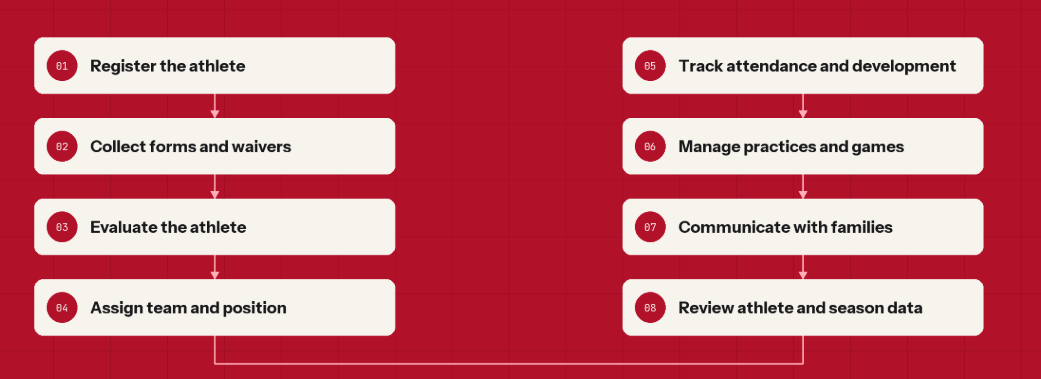
When these stages connect, a program ends up with a single operational workflow instead of eight disconnected steps.
American Football Athlete Management Software vs. Using Multiple Apps
| Area | Multiple Tools | Unified Platform |
| Athlete data | Scattered | Centralized |
| Rosters | Separate files | Connected |
| Evaluations | Coach notes | Digital records |
| Scheduling | Calendar apps | Team schedules |
| Communication | Group chats | Central hub |
| Payments | Separate system | Connected |
| Documents | Email or files | Athlete profile |
| Reporting | Manual | Centralized data |
The real argument here is not about having more features. It is about having connected information that does not require piecing together five different sources to answer one question.
Common Mistakes Teams Make When Managing Athletes
A few patterns show up repeatedly across programs that eventually decide to switch systems.
Relying entirely on spreadsheets works fine for a single small team but breaks down quickly once multiple people need to update the same file or once the roster grows past a size one person can track from memory.
Keeping evaluations separate from athlete profiles means development notes end up disconnected from the rest of a player's record, so nobody has a full picture in one place.
Using multiple communication channels creates a situation where an important update reaches some parents through a group chat, others through email, and a few not at all.
Tracking certifications manually works until the one certification nobody remembered to renew becomes a problem right before a game.
Treating registration and athlete management as separate processes means the same information gets entered twice, once at signup and again into whatever system the team actually uses day to day.
Choosing software that only solves scheduling addresses one visible pain point while leaving athlete records, evaluations, and compliance exactly where they were before.
From an administrator's side, it's easy to overlook the parent and athlete experience, but a system that confuses parents generates just as many phone calls and emails as having no system at all.
How Waresport Supports American Football Athlete Management
Waresport is a connected sports management platform built around exactly this kind of coordination. It covers athlete management with centralized profiles and records, roster and staff management across athletes, coaches, teams, and divisions, coaching support for practice planning and evaluations, scheduling across practices, games, and fields, registration and forms, communication across athletes and families, payments, and compliance tracking for certifications and documentation.
The American football management software page presents these pieces as one connected workflow, running from registration through scheduling, roster management, compliance, and season reporting, rather than as separate modules a program has to stitch together.
It is the process of managing an athlete's full lifecycle within a football program, covering registration, evaluations, development, participation, and communication.
It is a digital platform that centralizes athlete records, rosters, evaluations, scheduling, and communication for football programs, replacing spreadsheets and disconnected tools.
At minimum, athlete profiles, roster management, evaluations, attendance tracking, scheduling, communication, registration, payments, and compliance documentation.
Yes. Most platforms are built to handle multiple teams, divisions, and age groups within a single organization.
Yes. Digital evaluations let coaches log observations and track player development over time instead of relying on scattered notes.
Athlete management focuses on the individual player. Team management coordinates the group, including rosters, schedules, and staff.
Yes. It is particularly useful for youth programs managing parent communication, waivers, registration, and age divisions.
Yes. It helps manage eligibility, larger rosters, coaching staff, and complex scheduling across multiple teams.
Yes. While the format differs from tackle football, the underlying needs—registration, scheduling, communication, and roster management—remain much the same.
This is what we built Waresport for