
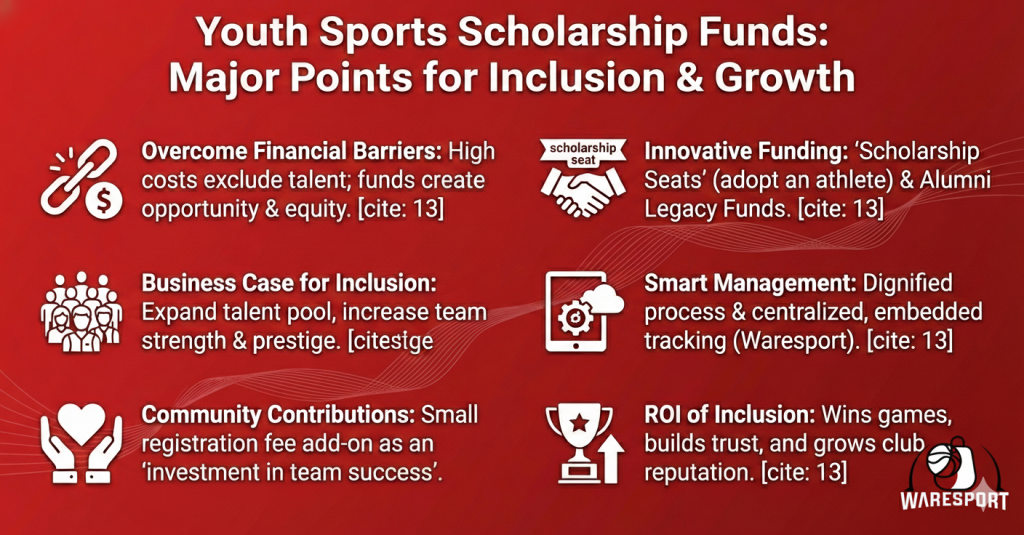
It’s clear there is a different narrative for every child playing youth sports today. Whether they have the skills, dedication, and work ethic to play, their opportunities are very limited based on a parent’s willingness and ability to pay to participate in youth sports; this difference in opportunity could be due to multiple factors such as income, race, or culture. Simply because they are unable to pay for their participation in youth sports does not mean those children don’t deserve the same opportunity to participate as well as others who have parents capable of paying. Youth sports scholarship funds would allow you to eliminate these inequities and allow every child to compete at the same level. It would not be fair that a player who has the talent and skills to compete at an elite level does not have an opportunity to play because their parent cannot afford to pay for their participation.The concept of youth sports scholarship funds is intended to provide financial support to children who would otherwise be unable to participate in youth sports due to financial constraints. The goal of a youth sports scholarship fund is to create a sustainable, ethical system that focuses on developing the youth athlete. Using the right sports team management software can help clubs track finances, scholarships, and player participation more efficiently.
The Unvarnished Truth About the “Absent Player”
Often when I think about financial assistance for youth travel teams the first thing that comes to my mind are the bureaucratic forms or legal obstacles that must be negotiated, but in truth, it’s about the young person who has no other option but to tell their teammates that “I’m done” simply because they cannot bring themselves to admit to those kids that their parents are unable to pay the $3,000 during the course of the season and all of the associated hotel costs. That’s a very heavy burden for a young person to carry around with them on a daily basis.
As event organizers, we sometimes become so lost in the quagmire of spreadsheets and venue reservations that we forget there are a considerable number of families who simply cannot climb the wall that the financial barrier creates. The loss of those players results in a decreased level of play for our entire league with the sole determination of the winners being based on which team has the best equipment rather than which team has the most talent. This has to be incorporated into the original budget from day one and not added in as an afterthought or as an “if we can afford it” expense.
The Business Case for Inclusion
When you limit player participation on the basis of ability to pay full “sticker price” to enter your club, you are limiting your talent pool; you are essentially fishing in a small pond. You might be missing out on a future world-class bowler or a future generational striker just because that player does not have the “travel ball budget”. You enlarge your talent pool and increase your team’s strength when you create a scholarship fund; you also enhance your league’s prestige. It’s not simply “doing good” – it’s creating a good business model. Winning teams win because they have access to the best athletes in the world, regardless of where they live. Winning teams will always attract the best players, no matter their income level.
Baking the Fund Right Into Your Registration Fees
The best way to begin your fund and be transparent about it, is by using a “Community Contributions” line item. The last thing many parents want to hear is that their fees are being raised. Let’s look at the math without any corporate jargon. If you anticipate your club will have 200 players and you add a relatively small $25 “Community Fund” fee to all of the registrations, you will have developed a $5k scholarship pool a lot quicker than you thought!
When you communicate to parents that by keeping excellent players with the team, the better chance there will be for success (they want to have fun too), it creates a completely different type of conversation; therefore, the cost associated with it, or the giving to the team, is no longer seen as a ‘tax,’ but an ‘investment in team success.’ Because of this, most parents are more than happy to contribute the equivalent of a couple of pizzas toward their child being able to play with and against the best possible players.
“It transformed what was perceived as an ‘individual cost’ into a ‘team win,’ and communicated that ‘we have each other’s backs’; that’s what a sporting community is about.”
By being open and transparent about this, you help to create a culture of openness. You are not hiding the cost; you are simply communicating that it is an important part of the club. This shows that you are more than a business; you are a part of the sporting community that values sport more than the dollar amount shown.
“Scholarship Seat” – an Alternative to Selling Your Logo to Every Local Business!
Each summer thousands of children play organized sports at every level of competition. Most of these children will have their names sponsored by businesses on banners at the fields or by advertising on equipment (e.g., jerseys). Most sponsors pay approximately $500 for these general fund sponsorships. After the season is over, the funds are typically used for new cones, game balls, painting field-lines, etc. But what if you pitched your sponsorship differently? Let’s say, for example, you sold “Scholarship Seats” instead of selling a logo.
Instead of asking a business to purchase a logo for their business to place on a banner or equipment, why not ask them to “adopt” an athlete’s season? This would be a much more compelling story for a business owner in your local community to take part in. They will now not only be a donor to your organization but also “a kid” who will now play because of their support.
For the business owner, you can show them how playing competitive sports positively impacts children through discipline, teamwork, and good health. Also, you can give them positive feedback on how much their donation helped the local athlete.
When you ask the business for support – a strong sales pitch will help you get the donation.
1. The Emotional Hook (what product do you sell): Show them how playing competitive sports affects a child’s life (discipline, teamwork, and good health).
2. The Tangible Result (what product do you sell): Your $1500 will guarantee a local athlete will attend every tournament during his/her season.
3. The Follow-Up (what product do you sell): After the athlete’s season is over, update the sponsor about your fundraising efforts. You do not need to include the athlete’s name; however, you must inform the sponsor that their donation helped local athletes.
Businesses desire a sense that they are effecting change through their actions. Putting a jersey on an underprivileged child who would typically not have an opportunity to play sports is a real example of this. This experience transforms the business and its customers from being a really dull transaction to something that becomes a real connection with the local community.
The Alumni Legacy Is a Resource
Every athletic club that has existed for a long enough time, typically 10 years old or more, has a unique resource at their disposal. This resource is the “Graduated” parents of former athletes in the club. These are the parents whose children are now in college or playing professionally. These former parents remember very well all of the travel to watch their children play, all the hotel stay, and the late nights spent driving at 1 AM to make it to tournaments on time. The alumni also have a level of loyalty to the organization that helped their child grow as an athlete and compete against other elite athletes.
By establishing a Legacy Fund, we allow alumni to give back to the current athletes that are following in their children’s footsteps through the organization. The Legacy Fund does not have to be a formal gala or have to be a high-pressure fundraising event. A simple, heartfelt email once a year at the beginning of the new competitive season, telling alumni about the new group of talented athletes and why the Legacy Fund is necessary, can go a long way toward asking alumni for their financial support. These alumni have experienced the very real “hidden costs” of travel sports. Most of these alumni will probably be in the financial position to positively impact the current generation of athletes by assisting them with their stated “hidden costs” that they are experiencing at this time. Ultimately, the Legacy Fund creates a cycle of support that exists beyond any one competitive season. The Legacy Fund also links the old guard of the organization with the new guard of the organization, creating a legacy for the organization that cannot be taken away with the money.
The Dignity of the Application Process
To maintain dignity throughout the application process you must avoid getting yourself tied up in knots (especially with the “legalistic” aspect). If someone feels like applying for financial aid is an embarrassing experience (i.e., like getting a welfare check) or if they feel that someone is “going to take me away” (i.e., like being arrested) then they will not apply. They’d rather quit than go through that experience. If it is possible to maintain dignity and keep the youth sports scholarship program process very simple, we will be able to give out scholarships.
No longer are we to ask for five years worth of tax returns, along with three pages explaining “why my child deserves this”. A simple yet sincere inquiry such as “are you able to pay for the entire stated amount or do you need some assistance?” is usually all you need to kick off an application.
| Instead of… | Try… |
| Proof of total household debt | A simple checkbox for “Free/Reduced Lunch” eligibility |
| A formal board interview | A private digital form on your dashboard |
| Publicly announcing recipients | An automated “Scholarship Credit” in the billing system |
The usage of a centralized management system provides the ability to manage and oversee all of the above activities without any one having to know that there are players who are currently on scholarship grants and other potentially confidential information regarding the players. The coach does not need to worry about how many players have scholarships. The team mother does not need to concern herself with that aspect either. The only thing that needs to be known is that the player is living up to his or her part of the scholarship by being on the field, prepared to compete in the sport.
New Kinds of Digital Fundraising in Today’s World
When I was a child, it was standard to participate in some type of “candy sale” or bake sale fundraiser where you would raise money to support your school or sport’s scholarship fund. Nowadays however, these types of fundraisers are not very effective and they consume a lot of time and energy from parents while raising little actual dollar revenue.
Who really wants to buy a $15 box of chocolate anyway?
Recently there has been a push in many different directions to have a more digital approach to fundraising through things like donation-based micro-fundraising using $5 – $10 donations made through social media for a specific purpose (i.e., covering the cost of travel for three of our players going to state).
These campaigns should be:
- Goal-oriented – For example: “We need to raise $1,200 by Friday to help pay for the travelling zoo bus for our field trip next month.”
- Shareable – Having a short link for parents to send to their family and friends (i.e., Aunts, Uncles, Grandparents) can help a fundraiser reach many different people outside of the team’s immediate community.
- Low-friction – When people see exactly what their money is going towards, they are more likely to donate to accomplish that goal.
Digital fundraising allows people to be active in helping provide a child with a specific reward (i.e., travel to a national tournament).Digital fundraising is quick, easy to see where their money is being spent, and avoids the physical chaos of collecting cash and product inventory. When you can provide someone with a tangible goal to help provide a specific win for the kids involved, your chances of getting a donation will increase.
Why Good Structure Allows Your Fund (and You) to Survive
You can raise a ton of money but if you don’t have a good structure in place to manage it, it’s going right down the black hole with all your general expenses. At this point, the dashboard becomes your new best friend. You need to know how much money is in your scholarship fund, who has received scholarship grants, and how much is left for the season.
When you use a Waresport-type system, the financial aid portion doesn’t exist in isolation from the system. Instead, it’s embedded into the system so that you can apply a scholarship credit to a specific player’s account in a matter of seconds – and the system then takes care of everything else. The level of clarity provided by this method removes the “where’d the money go?” level anxiety, and ensures that every dollar raised for scholarships goes to an actual scholarship. It transforms your “hobbyist” business model into a genuine, viable, professional organization that can be trusted to receive donations.
What Is The ROI Of Inclusion
“Why go to all this trouble for a few players” is a common question. A diverse & inclusive team is better-when you remove the financially based barrier to entry from your club, you increase your talent pool. By increasing your talent pool, you will win additional games. As you win more games, your club’s reputation will grow.
In addition to creating an increased level of trust between you and the parents of the children you serve, building a culture of “transparency” between you and your players. Parents will stay with a club that is trustworthy, and coaches will stay with a club that values their talent over their “bank account”. Creating a youth sports scholarship fund is not just a cost – it will become the most valuable asset your club will possess. It will be the difference between being a temporary stop on a kid’s journey or being part of their life story.
Conclusion
If you’re running a club or a league we recommend starting with structure. Make a decision today to put both your value and finances into a budget. Draw up that scholarship line item. Reassure those potential local sponsors of their ‘Seat’ proposal to donate to your organization. Make the application process easier for possible candidates.
Waresport believes we can achieve a world where the only thing stopping a player from playing sports is his or her level of effort, not the lack of funds from the parent’s wallet. Less chaos with more sport, all while being honest about what will be required for our children to play.
Let’s work together to ensure that no child ever has to walk away from the sport he or she loves because he or she was not included in the Budgets.
Want to see your clubs hit hundreds and have the best players? Start with a Waresport demo!!!
The best way is to set clear, objective criteria beforehand. Many clubs use a simple sliding scale based on participation in school “free and reduced lunch” programs. This takes the personal bias out of the decision and makes it a standard administrative process rather than a subjective one.
Not at all. In fact, many clubs find that “partial” scholarships (covering 50% or 75% of fees) allow them to help more families while still ensuring the family has “skin in the game.” It’s about bridging the gap between what a family can afford and what the season actually costs.
You should have a dedicated “restricted” line item in your accounting. If you’re using a management dashboard, you can tag these funds specifically for “Scholarships/Financial Aid.” This ensures that when you look at your balance sheet, you know exactly what money is “spoken for.”
Focus on the “ROI of Talent.” Tell them that their sponsorship is helping the team stay competitive by ensuring the best players in the region are on the roster. You aren’t asking for a handout; you’re asking them to invest in a community asset that develops local leaders.
While some clubs have “work-study” programs, you have to be careful. It can sometimes “out” the scholarship kids to the rest of the club, which ruins the privacy of the aid. It’s often better to ask all families to volunteer equally and keep the financial aid purely financial.
This is what we built Waresport for